











Surfactants
Advanced Chemistry to Enhance Fluid Control
Surfactants act as a bridge between the many interactions of oilfield water and chemistry. We develop custom formulations to address the unique properties of each well and to maximize hydrocarbon recovery.

Water Experts
Effective surfactant selection starts long before the lab. We begin by understanding your formation, your frac water, and every other chemical already in your package — because friction reducers, biocides, and scale inhibitors all have surfactant-like properties that affect how your chosen chemistry performs. Evaluating a surfactant in context gives you a more complete picture of field performance.
Our chemistry teams test with actual field water, at reservoir temperature, with your full chemical package in the mix — every time. That’s how we ensure the recommendation we make in the lab holds up in the field.

Applications
Get more from your Formation.
-

Fluid Recovery and Production Optimization
Reducing the interfacial tension between oil and water, lowering flow resistance at every interface in the reservoir. The result is faster, more complete fluid recovery — on both oil and water.
-

Wettability Alteration
The right surfactant shifts that surface from oil-wet to water-wet, reducing corrosion, improving relative oil permeability. and supporting better production over time.
-

Emulsion Control
Lower interfacial tension increases emulsion risk if chemistry isn’t carefully managed. We balance IFT reduction with non-emulsification requirements to protect both reservoir performance and surface equipment.
Other functions include Acid Stimulation, Enhanced Oil Recovery, Foamers, and Defoamers.

Testing Workflow
A Smarter Way to Evaluate
Tile Test
A fast, visual wettability screening that narrows 20+ candidates for further testing.
Critical Micelle Concentration (CMC)
Identifies the optimal starting dosage for best performance on the full frac package, not just water. This distinction significantly changes the result and protects against overdosing or underdosing in the field.
Interfacial Tension (IFT)
Measuring how effectively a surfactant reduces tension at the oil-water interface, while monitoring emulsion risk to find the right performance balance.
Contact Angle & Wettability
Utilizing core samples or well cuttings to quantify shifts in wettability toward a more water-wet state.
Compatibility Testing
Testing the full chemical package at field temperature and pressure to identify interactions and opportunities for synergy between chemistries.
Porous Media Evaluation
Sand-and-cuttings pack test that simulates gravity drainage, providing quantitative fluid recovery data before field deployment.
MicroFluidics
Reservoir On a Chip
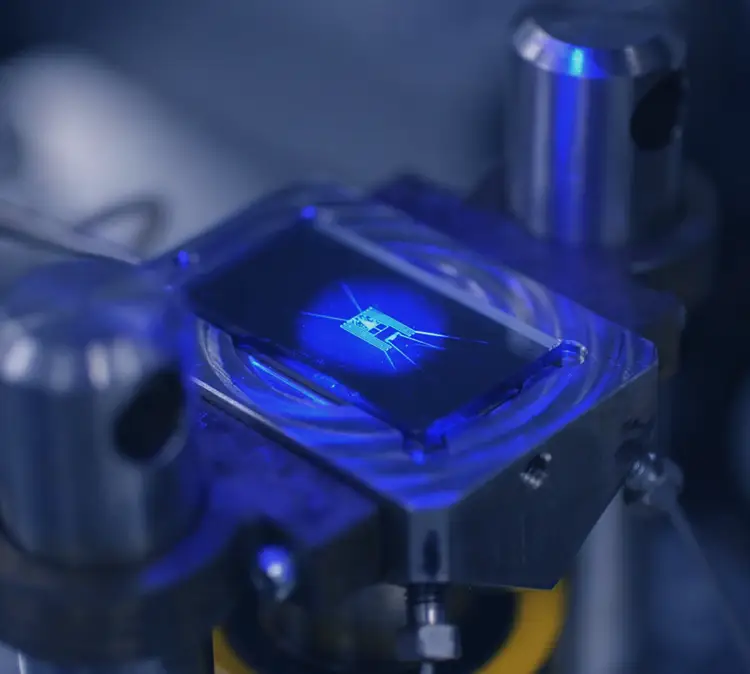
When customers need surfactant recommendations in days, not months, traditional core flooding tests don’t fit the timeline. Our use of microfluidics — a laser-etched silicon wafer that simulates the fracture network, proppant pack, and shale matrix under actual reservoir temperature and pressure — was designed to close that gap.
We visualize oil and water movement in real time, quantify production performance, and measure regained conductivity across competing chemistries and dosages — all with the speed and repeatability that field schedules demand.
It’s not a shortcut. It’s a more precise way to evaluate the right chemistry for your well before you pump it.
Expert Research & Development Teams
Our research and development team is focused on advancing surfactant technology built specifically for unconventional completions — not repurposed from conventional EOR applications. Shale formations have different mineralogy, different scales, and different objectives than traditional flood projects. We account for that at every stage of product development and evaluation.
By integrating surfactant testing into the broader frac fluid package, we’re able to identify how chemistry interactions affect real-world outcomes — and recommend the product and dosage combination that delivers measurable results.

Direct to Field Logistics & Mobile Treatment
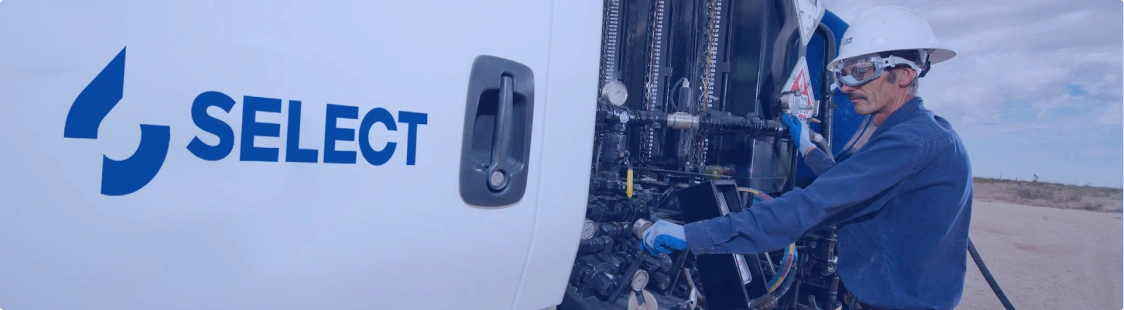
Our efficient delivery and precise dosing of surfactants keep your operations chemically optimized at every stage. As a trusted partner with in-house fleets and a proven track record, we help you optimize your supply chain and reduce costs while maintaining efficiency.
With a commitment to reliability and operational excellence, we keep your project on track from start to finish.

Related Resources



Connect with a
Chemistry Expert
We have cultivated a team of seasoned water and chemistry professionals, trained extensively to advise and execute optimal water and fluid chemistry plans that cater to environmental, cost, and project timeline considerations.