






A Midland Basin operator evaluated surfactant addition and dosage optimization for their hydraulic fracturing program. Laboratory testing using the operator’s produced water and crude oil at reservoir temperature quantified oil flowback recovery across six dosage steps (0.00–1.25 gpt). Results demonstrated a 112% recovery increase from untreated baseline to the recommended optimum of 0.75 gpt, with incremental gains diminishing sharply at higher concentrations.
Background
An operator in the Midland Basin was considering surfactant chemistry for their completions program and needed to establish two things: whether surfactant addition would produce meaningful recovery improvement under their specific reservoir conditions, and what dosage represented the best balance of performance and chemical spend.
A key requirement was full compatibility with the existing chemistry package, which included friction reducers, biocides, and scale inhibitors. Compatibility was confirmed across all dosage steps prior to performance evaluation.
Methodology
Testing was conducted using Select Chemistry’s microfluidic evaluation platform — a laser-etched silicon wafer designed to replicate the fracture network, proppant pack, and shale matrix under actual reservoir temperature and pressure. This approach enables real-time visualization of oil and water movement at the pore scale, quantification of production performance, and measurement of regained conductivity across competing chemistries and dosages. The operator’s actual produced water and crude oil were used as test fluids throughout.
Oil flowback volume (nl) was measured at 60 minutes across six dosage steps. (see table)
The untreated baseline was included to establish absolute recovery without chemical addition — a necessary reference point for quantifying the full economic impact of surfactant use, not just incremental differences between dosage steps.
| Dosage | Oil Flowback (nl) | Recovery Increase (vs. prior step) |
|---|---|---|
| 0.0 gpt (baseline) | 85.15 | — |
| 0.25 gpt | 121.1 | +42.2% |
| 0.50 gpt | 158.4 | +30.8% |
| 0.75 gpt | 180.7 | +14.1% |
| 1.00 gpt | 190.0 | +5.2% |
| 1.25 gpt | 193.9 | +2.0% |
Table 1. Oil flowback recovery by dosage step. Recovery Increase reflects step-over-step gain vs. the prior dosage level.
Results
The untreated baseline recovered 85.15 nl of oil at 60 minutes. Introduction of surfactant at the lowest evaluated dosage (0.25 gpt) increased recovery to 121.1 nl — a 42.2% improvement over no treatment.
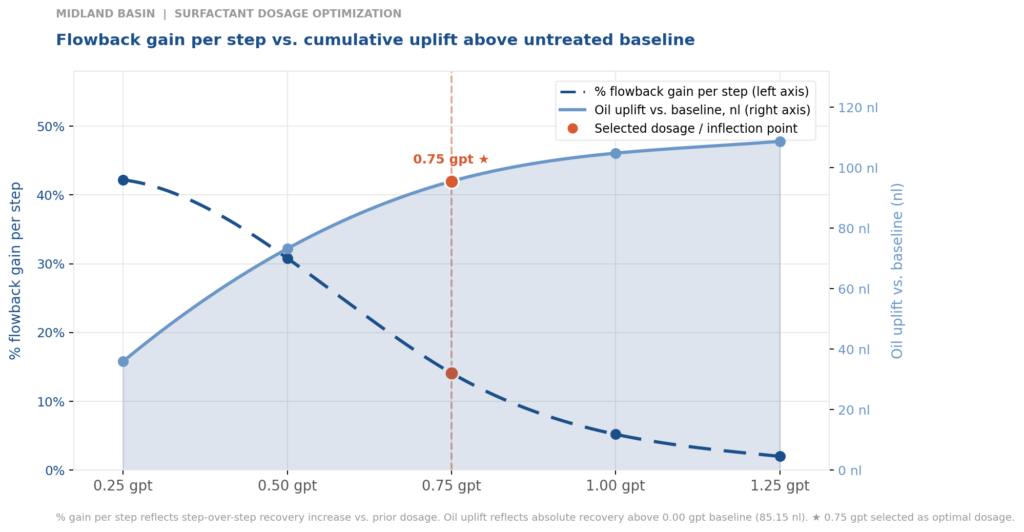
Recovery continued to increase with each subsequent dosage step, but the rate of incremental gain declined consistently. (see chart)
The steepest inflection in the recovery curve occurs between 0.75 and 1.00 gpt. At 0.75 gpt, cumulative recovery had reached 180.7 nl — 112% above the untreated baseline. Dosage increases beyond this point produced diminishing marginal recovery relative to the additional chemical volume applied.
Discussion
The data supports 0.75 gpt as the optimal dosage for this operator’s conditions. The marginal recovery gain from 0.75 to 1.00 gpt (+5.2%) and from 1.00 to 1.25 gpt (+2.0%) represents a substantial reduction in return per unit of chemical spend compared to earlier dosage steps.
The baseline comparison is the more consequential finding for programs that have not yet incorporated surfactant chemistry. The 112% recovery increase from 0.00 to 0.75 gpt reflects the magnitude of recoverable oil that conventional completions — without surfactant — leave behind in these reservoir conditions. This figure is specific to the tested water chemistry, crude, and temperature; results will vary by formation, but the directional conclusion holds across most unconventional plays where interfacial tension is a limiting factor on flowback efficiency.
All tested formulations confirmed full compatibility with the incumbent chemistry package, with no emulsion formation or precipitation observed across the dosage range evaluated.
Field Outcome
The operator implemented surfactant at the recommended 0.75 gpt dosage. Field results showed a significant production increase relative to a sister well completed without surfactant.